
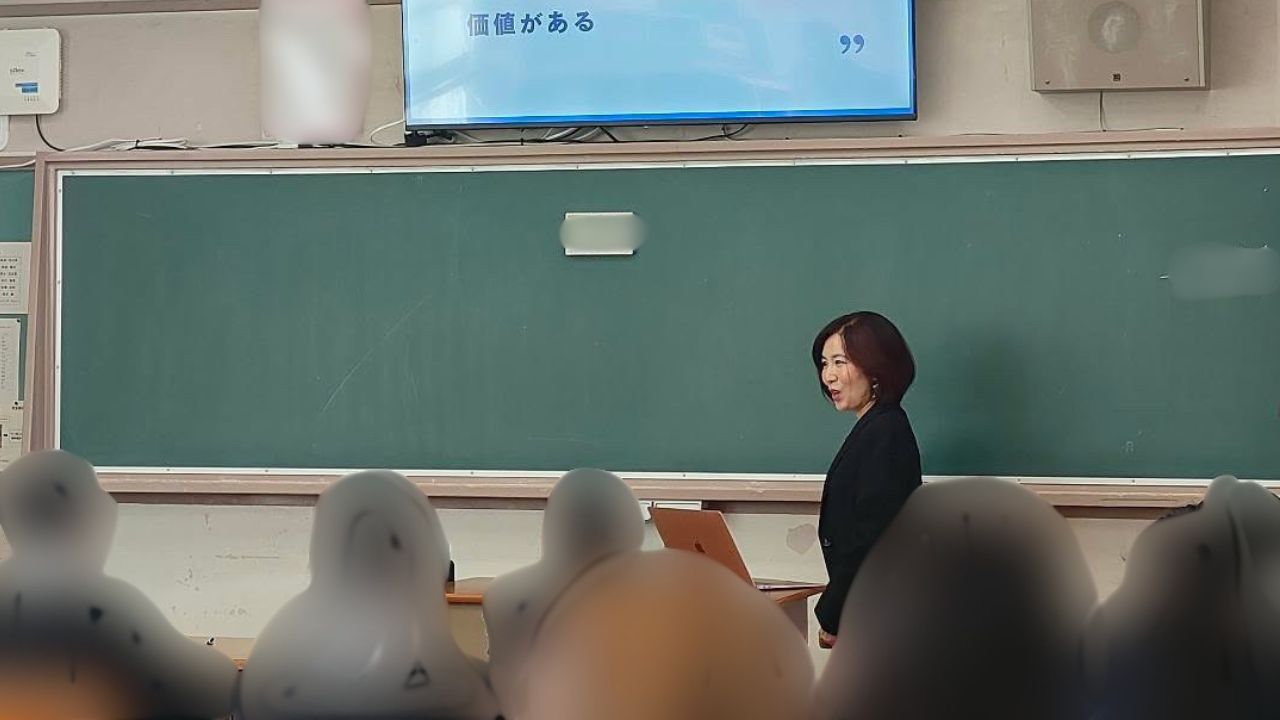
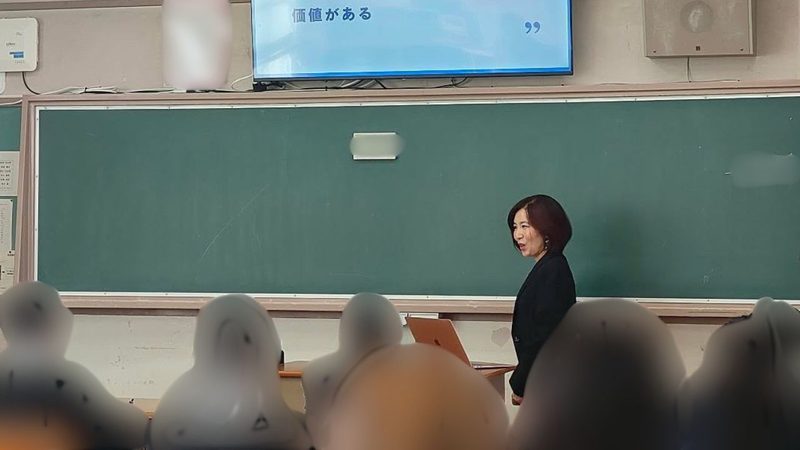
Recently, I had the opportunity to deliver two career talks to second-year students at Kohoku junior high school in Nagoya-shi, Japan.
At the end of one session, a boy stood up to share his thoughts. His eyes were red with emotion.
“I used to struggle with speaking in front of people, too. But hearing that you went through the same thing gave me confidence. Now I want to challenge myself.”
His words moved me deeply.
Because there was a time when I didn’t just struggle with public speaking.
I hated it.
Today, I work as a speech coach, helping business leaders and speakers communicate with greater authenticity and impact. But my journey began with a very different relationship with my own voice.
That day reminded me of something I have come to believe:
An experience we once considered a weakness can become a source of possibility for someone else.
What Did I Really Want These Students to Take Away?
The purpose of the career talks was to introduce students to my work as a speech coach and speaker, including Body Speech, the communication approach I developed.
I also incorporated experiential exercises so students could explore communication through their own bodies, rather than simply listen to explanations.
But as I prepared, one question kept returning:
What do I truly want to share with students at such a formative stage of their lives?
I revised the presentation repeatedly. My slides were finally ready the night before, yet I continued refining the message late into the night.
Eventually, I made a decision.
Instead of trying to deliver a perfectly polished presentation, I would show up as myself.
That meant sharing not only what I do today, but also the experiences that once made me doubt myself.
The Girl Who Was Terrified of Speaking
As a student, being called on in class was one of my greatest fears.
My heart would race. My mind would go blank. I would look down, unable to find the words.
The classroom would fall silent.And the longer the silence lasted, the more desperately I felt I had to say something. Yet the harder I tried, the more difficult speaking became.
I was afraid of everyone’s eyes on me. Sometimes, the frustration of being unable to express myself turned into tears. Meanwhile, other students seemed able to share their opinions so confidently.
Why can’t I speak like them?
I compared myself with others and gradually came to believe that public speaking was simply something I could not do.
Looking back, it is remarkable that I now spend my professional life helping others speak.
But that transformation did not happen overnight.
When an Insecurity Becomes a Strength
For years, I saw my fear of public speaking as a weakness I needed to overcome.
Then, at some point, I began to see it differently.
Perhaps because I struggled so much, I can understand what others experience when they struggle to speak.
I know what it feels like to stand in front of people and lose your words.
I know the frustration of having something to say but being unable to express it.
And I know how easily comparing yourself with confident speakers can make you question your own abilities.
What I had once considered a disadvantage might also allow me to support others with greater understanding.
That shift in perspective became one of the turning points in my professional journey.
Of course, changing my perspective did not magically make me a confident speaker. I studied, practiced, made mistakes, and gradually developed my own way of expressing myself.
But I began to question the belief that had limited me for so long:
I am simply someone who cannot speak in front of others.
Perhaps that was never the whole story.
When the student told me that hearing about my experience had given him the courage to try, I realized that something which once caused me pain had become a source of encouragement for someone else.
Body Speech: Self-Expression as a Path to Self-Understanding
As the founder of Body Speech, one of my central beliefs is:
Self-expression is a path to self-understanding.
When people think about public speaking training, they often focus on techniques: vocal delivery, eye contact, gestures, pacing, and posture. These skills matter.
But communication is not simply about performing the right techniques.
A person may deliver a beautifully structured speech and still feel disconnected from what they are saying.
That is why, in my work, I invite people to explore questions such as:
What am I really feeling?
What matters most to me?
What do I want the audience to understand or experience?
Why does this message matter to me?
Body Speech is an approach that explores the connection between the body, words, and intention.
Through the process of finding our own words, speaking them aloud, and experiencing how they resonate within our bodies, we can begin to understand ourselves more deeply.
And when we develop a more authentic relationship with ourselves, we create the possibility of a more authentic connection with others.
This is why I believe learning to express ourselves is not only a communication skill.
It is also a life skill.
Finding Our Own Voice in the Age of AI
Today, artificial intelligence can help us draft speeches, structure presentations, and produce polished language in seconds.
I see tremendous potential in these technologies.
But their convenience also makes one question increasingly important:
Before asking, “What should I say?” we need to ask, “What do I truly want to communicate?”
AI can help organize our thoughts and refine our language.
But it cannot make our personal choices for us: what we value, what we stand for, or how we want to live.
Those decisions remain ours.
We don’t need to have perfectly formed ideas from the beginning.
Sometimes, finding our voice starts with noticing a small feeling, a question, or a sense that something is not quite right.
By paying attention to those signals and gradually putting them into words, we develop not only our ability to communicate, but also our understanding of who we are.
If We Want Young People to Be Courageous, We Must Keep Challenging Ourselves
One of my lifelong aspirations is to bring speaking and presentation education to students in Japan and around the world.
My goal is not simply to help young people become polished public speakers.
I want them to discover that they have the ability to think for themselves, make their own choices, and express what matters to them. To me, finding your own voice is closely connected to taking ownership of your own life.
Think for yourself.
Choose for yourself.
Take action, even if the first step is small.
Each of these experiences can open new possibilities for the future.
But I also believe that telling children to be courageous is not enough.
As adults, we need to continue taking risks, facing uncertainty, and learning ourselves.
I still experience doubt. I still rethink my decisions. I still take on challenges without knowing exactly how they will turn out.
Preparing for this school visit was one of those moments.
I could have focused on delivering a flawless presentation. Instead, I chose to share a vulnerable part of my own story.
And a student responded by telling me he wanted to challenge himself, too.
His courage encouraged mine.
I believe one of the most powerful ways adults can educate children is by showing them what it looks like to keep growing.
Life Is a Stage. You Are the Main Character.
There is a phrase I hold close to my heart:
“Life is a stage. You are the main character.”
You don’t have to speak like anyone else.
You don’t have to follow someone else’s path.
And the things you struggle with today do not have to define what is possible for you tomorrow.
I hope more young people will learn to listen to their own thoughts, express themselves in their own words, and make choices that reflect who they are. And I intend to keep practicing that myself.
My sincere thanks to the teachers who invited me and to the students who participated with such openness and sincerity.
Speaking Engagements, Educational Programs, and Body Speech Coaching
Through Body Speech, I support individuals in developing authentic communication by connecting their intentions, words, and physical expression.
My work includes speech and presentation coaching for business leaders and speakers, as well as career talks, educational presentations, and experiential workshops for students.
I welcome opportunities to collaborate with schools, educational institutions, and organizations in Japan and internationally.
For speaking engagements, workshops, or coaching inquiries, please contact us through the website.
コメント