
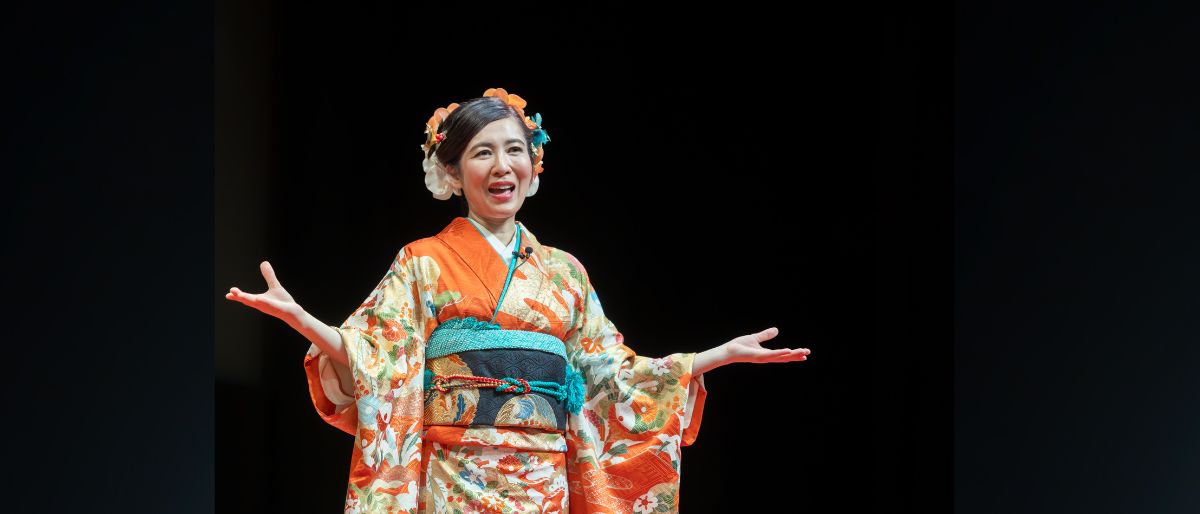
By Mayumi Ogata | Founder of Body Speech | Global Speech Coach
Body Speech is a communication framework that reveals how your inner state — your nervous system, breath, and emotion — is perceived by others before you say a single word, shaping trust, influence, and human connection.
There are moments when someone walks into a room and, before they say a single word, you already trust them.
And there are moments when someone delivers a technically flawless presentation — clear slides, polished language, confident tone — yet something feels strangely disconnected.
Most people cannot explain this feeling logically. But the body notices it immediately.
For most of my life, I have been trying to understand why.
Why do some people naturally create trust, influence, and emotional resonance — while others, despite having knowledge and preparation, struggle to truly reach people?
The answer I eventually discovered was simple, but profound:
Human beings are constantly communicating through the body before language is ever processed consciously.
I call this phenomenon Body Speech.
Body Speech Is Not “Body Language”
You may have experienced this before:
someone saying “I’m confident,” while their breathing, eyes, and body quietly communicated fear.
Or someone saying very little — yet somehow making the entire room feel calm.
People often assume Body Speech is another version of body language training — posture, gestures, eye contact, or presentation technique.
It is not.
Body language focuses on outward behaviors. Body Speech focuses on the internal state that unconsciously creates those behaviors.
Because the body cannot fully hide what the nervous system is experiencing.
Your breathing changes before your voice does. Your muscle tension shifts before your words become unstable. Your gaze reveals emotional pressure before your logic collapses.
Long before people consciously decide what they think about you, they are already sensing:
- Is this person safe?
- Can I trust them?
- Do their words and body match?
- Are they grounded, or performing?
- Do I feel tension around them, or coherence?
Much of this evaluation happens unconsciously. And that silent perception profoundly influences trust, leadership, persuasion, connection, credibility, and presence.
Body Speech is the phenomenon in which your inner state speaks through your body before words are ever spoken — shaping how you’re perceived, trusted, and followed. It is the study of that invisible communication.
The content presented in this article is offered as an original framework that integrates the author’s lived practice with insights from nonverbal communication research, neuroscience, and psychology.
The Origin of Body Speech
Body Speech did not begin as a business idea or communication framework. It began through lived experience.
As a child shaped by trauma, I became highly sensitive to emotional incongruence. I learned very early that words were not always reliable indicators of truth.
Someone could say “I’m fine” while their breathing tightened. Someone could smile while their shoulders collapsed inward. Someone could speak gently while their presence communicated fear, control, or anger.
Without realizing it, I began reading people through the body.
As a young child, I entered the world of performing arts. Across more than 40 years of stage experience and 83 performances in five countries, I encountered the same phenomenon repeatedly.
Some performers could technically execute every line perfectly, yet fail to move the audience emotionally. Others made mistakes, paused unexpectedly, or spoke imperfectly — yet completely captivated the room.
Why?
Because audiences do not respond only to words. They respond to embodied truth.
What performers and audiences have known intuitively for centuries, somatic psychology and neuroscience are now beginning to confirm: the body is profoundly shaped by emotional and physiological states, and those states are communicated to others through expression, posture, and voice — often before a single word is spoken.
I later saw the same pattern while counseling over 7,000 clients across 18 years, and while coaching leaders, executives, entrepreneurs, TEDx speakers, and professionals internationally.
Again and again, I observed that communication problems were rarely caused by lack of intelligence, preparation, or effort.
The deeper issue was always misalignment.
Their words were moving in one direction while their body, nervous system, and emotional state were moving in another. People could feel it — even if nobody said it out loud.
That observation eventually became the foundation of Body Speech.
The Core Principle of Body Speech
At its core, Body Speech is based on one fundamental principle:
Before your words are evaluated, your state is already being perceived — unconsciously — by those around you.
This means communication is not only about what you say. It is also about the condition of your nervous system, the quality of your breathing, your relationship with tension, whether your body feels safe, whether your emotions and intentions are coherent, and whether you can remain present under pressure.
This is not intuition alone. In neuroscience, research such as Stephen Porges’ Polyvagal Theory suggests that the human nervous system continuously evaluates the environment for signals of safety and threat — long before conscious thought processes them. This aligns with findings in psychology showing that first impressions are formed almost instantaneously.
This is why two people can say the exact same sentence — and create completely different emotional responses. One feels convincing. The other feels performative. One creates safety. The other creates subtle discomfort.
Words matter. But the body determines whether those words feel believable.
Body Speech integrates three elements:
1. Neuroscience and psychology — understanding how the brain processes information and evaluates trust at a biological level.
2. Heart-centered intention — communicating not only from logic, but from the genuine emotion and purpose behind your message.
3. Embodied expression technique — translating that inner state into visible form through posture, gaze, and breath. This draws from ancient principles of alignment between body, word, and mind — made reproducible for anyone.
Presence Is Not Performance
One of the biggest misunderstandings in modern communication is the belief that “presence” is something artificial — charisma, dominance, confidence, or performance.
But true presence is not performance.
Presence is coherence.
It is the condition in which your body is not fighting your words, your nervous system is not collapsing under pressure, your emotions are not disconnected from your message, and your intention is fully integrated into how you speak and exist.
This is why some people feel powerful without speaking loudly. Their body is not asking for approval. It is not chasing evaluation. It is simply aligned.
People feel that alignment instinctively. And trust emerges from it naturally.
True presence is not the absence of fear.
It is the ability to remain connected to yourself even while fear exists.
Why Body Speech Matters in the AI Era
We are entering a world where information is abundant and persuasive language can be generated instantly. AI can already produce articles, presentations, scripts, and speeches at remarkable speed.
But there is something AI has not yet been able to fully replicate:
Embodied presence.
AI can imitate patterns of communication. It can generate convincing language. It can even simulate facial expressions and gestures. But human beings still sense the difference between performed expression and lived coherence.
This is why the future of communication will not belong solely to those who speak the loudest or produce the most information.
It will belong to people whose presence feels real.
People who can remain grounded under pressure. People whose words match their nervous system. People who can create emotional safety, trust, and resonance through alignment.
In an age of artificial communication, embodied humanity becomes more valuable — not less.
Beyond Communication: Designing Presence
Over time, Body Speech evolved beyond public speaking or communication coaching. It became a framework for understanding human evaluation itself.
Because whether in leadership, relationships, business, negotiation, performance, or daily life, people are constantly asking one unconscious question:
Does this person feel coherent?
Body Speech is not about manipulation. It is not about controlling impressions.
It is about designing presence through alignment.
The alignment of body, emotion, intention, breath, attention, and expression.
When these move together, communication becomes deeply human. And when communication becomes deeply human, trust naturally follows.
My Vision
My vision is to make Body Speech a universal language.
Sometimes it begins very quietly:
a deeper breath,
your feet reconnecting with the floor,
your shoulders softening,
your body no longer fighting itself.
And from that moment, people feel the difference.
Not a niche methodology. Not a coaching technique for the privileged few.
A language that every human being already carries in their body — and can learn to speak consciously.
Because the nervous system does not have a nationality. Breath does not have a cultural border. The fundamental way in which the body communicates safety, trust, and coherence shares common elements that transcend culture.
Body Speech is already universal. My work is simply to make it visible.
Because before your words are heard, your presence is already speaking. And that language — the language of the body — belongs to all of us.
If you’d like to explore further:
→ Why We Misunderstand Each Other — And the Biological Truth the Body Already Knows (Medium)
→ Why do some givers thrive while others burn out? (Medium)
For more on the Body Speech framework (Official Site)
Ready to experience Body Speech?
If this resonated with you, the most direct next step is a one-on-one discovery session — where we explore how your body is already speaking, and what becomes possible when it aligns with your words.
→ Book a Discovery Session (Official Site)
Prefer to begin at your own pace?
→ Body Speech Online Course (Udemy)
— Mayumi Ogata
Founder of Body Speech
Global Speech Coach | Keynote Speaker | Author
LCC Most Experienced Coach 2026
Mayumi Ogata Official Site | Medium
コメント