

Even when we use exactly the same words, the way we deliver them can change how our message is received.
Eye contact, pauses, gestures, and the way we use our bodies all influence how we communicate.
But how can these elements be developed through practical presentation coaching?
Recently, I returned as a guest instructor for an English Presentation and Discussion course.
In my previous session, participants explored nonverbal communication through interactive exercises, experiencing firsthand how physical expression can influence the way a message comes across.
This time, we took the next step: putting those skills into practice.
Ten participants delivered their own presentations in English, and I provided personalized feedback to each of them.
Ten speakers, ten different topics, and ten different ways of communicating.
Rather than teaching everyone a single “correct” way to present, I focused on helping each participant align their body, words, and intention so that their message could reach the audience more effectively.

From Interactive Learning to Practical Presentation Coaching
In the previous session, we explored four essential elements of nonverbal communication:
- Pauses and timing
- Eye contact
- Gestures
- Posture and physical presence
Rather than simply discussing these concepts, participants experienced them through physical exercises and observed how even small changes could influence communication.
In this follow-up session, each participant delivered a presentation in English and received individual feedback.
Their topics ranged from language learning to fashion, health, and other subjects.
As I listened to each presentation, I wasn’t simply checking whether the speaker was using enough gestures or looking at the camera.
I was considering a more fundamental question:
“Who are you speaking to, why are you saying these words, and what do you want your audience to take away?”
With that intention in mind, I offered specific suggestions for using physical expression to support each speaker’s message.
“I Believe”: Expressing Conviction Through the Body
One participant used the phrase:
“I believe…”
These two words can carry a powerful sense of personal conviction.
During the feedback session, I suggested:
“Try placing your hand on your chest and looking directly into the camera as you say this.”
Of course, placing a hand on your chest is not a universal rule for saying “I believe.”
What matters is whether the speaker’s physical expression supports the meaning of the words.
When someone expresses a personal belief while looking down at their notes or unconsciously swaying, the strength of that conviction may not fully come across.
Instead, imagine pausing for a moment, becoming physically still, placing a hand on your chest, and looking toward the audience.
The words remain exactly the same.
But the way they are received can change.
“You Are Wonderful”: Who Are You Speaking To?
Another participant included the phrases:
“You are wonderful.”
“You are amazing.”
These are words directed toward another person.
And when we speak directly to someone, the direction of our attention matters.
In online presentations, speakers often look at their notes or at the faces displayed on their screens.
However, when delivering a message directly to the audience, looking into the camera can help create a stronger sense of connection.
I suggested:
“Imagine you’re speaking to one person right in front of you. Look into the camera as you say these words.”
When you say “you,” who is that person?
The moment you become aware of the person receiving your words, your delivery begins to change.
The sentence is no longer simply something you are reading from a script.
It becomes a message you are intentionally delivering to someone.
This is one example of how I work with speakers to connect the meaning of their words with their eye contact and physical expression.
Ten Participants, Ten Different Approaches to Feedback
One of the most important aspects of this session was that I did not give the same advice to everyone.
To one participant, I suggested:
“Try taking a short pause here.”
To another:
“Let’s use a gesture to make the meaning of this sentence more visible.”
And to someone else:
“Here, try staying completely still and delivering the message without any movement.”
Effective presentation skills are not simply about using more gestures or maintaining constant eye contact.
For example, when comparing two ideas, using both hands can help the audience visualize the difference.
After asking a question, allowing a moment of silence gives listeners time to think.
And when delivering a particularly important message, becoming still and looking directly at the audience can sometimes be more effective than adding movement.
Movement is expression. Stillness is expression, too.
This is something I have learned through my many years of experience on stage.
Movement makes stillness stand out.
And stillness gives meaning to the movement that follows.
The same principle applies to presentations.
The goal is not to move more.
It is to choose how to use the body according to the meaning and purpose of the message.
Pauses Are Designed for the Listener
Another important focus of the feedback was the use of pauses.
A pause is not simply a moment when the speaker stops talking.
After asking a question, a pause gives the audience time to think.
After delivering an important message, it gives listeners time to absorb what they have heard.
And when the audience responds, a pause allows the speaker to acknowledge that response.
Although these moments may all look like silence, they serve different purposes.
I often compare presenting to playing catch.
When you throw a ball, you wait for the other person to catch it.
Communication works in much the same way.
After delivering a message, we need to give the audience time to receive it.
At first, it can be helpful to practice a simple technique, such as waiting two seconds after asking a question.
But ultimately, the goal is to develop the ability to sense the audience and allow pauses to happen naturally.
In this session, I encouraged participants to think about pauses not only as a speaking technique, but also as a way to create space for their listeners.
Why Nonverbal Communication Matters in English Presentations
When presenting in English, especially as a non-native speaker, it is natural to focus on grammar, pronunciation, vocabulary, and remembering the script.
Preparation and language accuracy are important.
But the purpose of a presentation is not simply to reproduce a memorized script without mistakes.
It is to communicate ideas and messages to an audience.
That requires attention to more than words alone.
For example:
- When should you look directly at your audience?
- Where should you pause?
- Which words might benefit from a gesture?
- When would stillness be more effective?
- How can your posture support the message you want to convey?
During the session, we explored these questions through each participant’s actual presentation.
Because every speaker had a different topic, personality, and communication style, the feedback needed to be different as well.
My goal is not to make everyone speak in the same way. It is to help each person use their own strengths to communicate more effectively.
That is one of the principles at the heart of my presentation coaching.
Body Speech: Aligning Body, Words, and Intention
Body Speech is a communication approach I have developed through my experience in physical expression on stage and my work coaching speakers and leaders.
It is not simply about improving posture or adding gestures to a presentation.
Body Speech is about aligning body, words, and intention to build trust and presence.
During this session, every piece of feedback began with the same fundamental question:
“What is this person really trying to communicate?”
Is the speaker expressing a personal belief?
Asking the audience to reflect on something?
Comparing two ideas?
Explaining information?
Or delivering a message they want listeners to remember?
The intention behind the words determines how the body can best support them.
Drawing on my years of stage experience and my work with speakers and leaders, I incorporate these principles into practical presentation coaching.
This follow-up session gave participants an opportunity to apply the pauses, eye contact, gestures, and posture explored in the previous workshop to their own English presentations.
Applications for Corporate Training, Leadership Development, and Education
This English Presentation and Discussion course combined interactive learning with practical presentation coaching and personalized feedback.
The same principles can be applied well beyond English-language presentations.
They are relevant to a wide range of professional communication settings, including:
- Leadership presentations
- Corporate communication and business presentations
- Online meetings and virtual presentations
- Public speaking and keynote presentations
- Educational presentations and classroom communication
Preparing what to say is only one part of effective communication.
How we deliver our message matters just as much.
Through Body Speech, I help speakers explore how eye contact, pauses, posture, gestures, and physical presence can support what they want to communicate.
Corporate Training, Speaking Engagements, and Media Inquiries
I offer corporate training, speaking engagements, educational workshops, and media interviews on topics including presentation skills, leadership communication, nonverbal communication, physical expression, virtual communication, and executive presence.
My work may be particularly relevant to organizations looking to:
- Strengthen presentation skills among leaders and managers
- Develop communication skills that go beyond words
- Improve nonverbal communication in English presentations
- Incorporate practical exercises and personalized feedback into training programs
- Help professionals communicate with greater trust, confidence, and presence in online and in-person settings
Depending on the goals of the organization, sessions can incorporate lectures, interactive physical exercises, and individualized feedback based on participants’ actual presentations.
For corporate training, educational programs, speaking engagements, or media inquiries, please feel free to get in touch.
Learn More About Body Speech
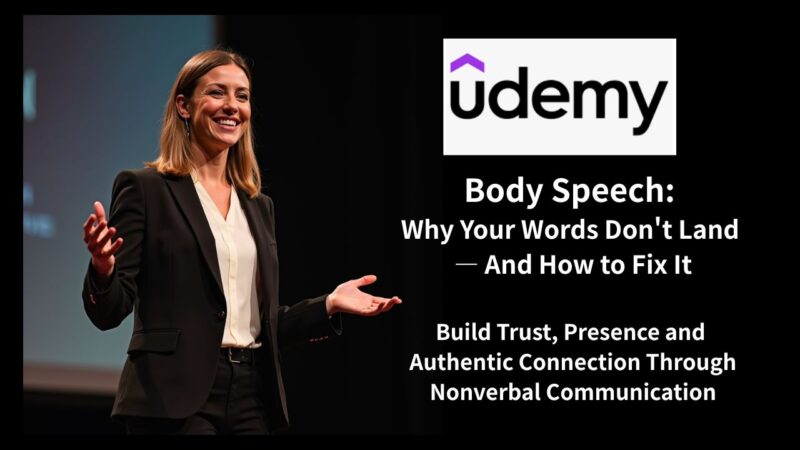
For those who prefer to learn Body Speech in English, I also offer an online course on Udemy.
Body Speech: Why Your Words Don’t Land — And How to Fix It
This course explores how physical presence, body awareness, and nonverbal communication influence the way our messages are received.
It is designed for anyone who wants to move beyond simply choosing the right words and develop a more intentional, authentic, and effective way of communicating.
コメント