
Imagine joining an online session and seeing a speaker you have never met suddenly appear on your screen.
For a moment, you may find yourself wondering:
Who is this person?
What will this session be like?
Will I be able to keep up?
Even when we are not consciously aware of it, the body can become slightly tense in those first few seconds.
But this is not only a challenge for participants.
It is also an important moment for the person leading the session.
Of course, speakers prepare their content carefully.
But when I design a presentation, a workshop, or a talk, I spend a great deal of time thinking about something that happens before the first sentence:
What kind of space do I want to create in the first few seconds?
Because communication has already begun before we speak.
What happens when a new guest suddenly joins the fourth session?
Recently, I was invited as a guest speaker for an English presentation and discussion course.
It was already the fourth session.
The participants knew one another. They had already developed a sense of familiarity and connection.
And then a new person—me—suddenly appeared on their screens.
Of course, I had watched recordings of the previous sessions and prepared carefully.
But I still did not know what each participant would be like in the actual room.
I began to imagine what might happen if I simply appeared and immediately said,
“Hello. Today, I’m going to talk about Non Verbal Communication.”
The participants might listen.
But would they already feel ready to participate?
That distinction mattered to me.
So I decided to introduce a small intervention before I began speaking.
The first five seconds: do something before you speak
I chose something very simple:
a High Five.
Not just once.
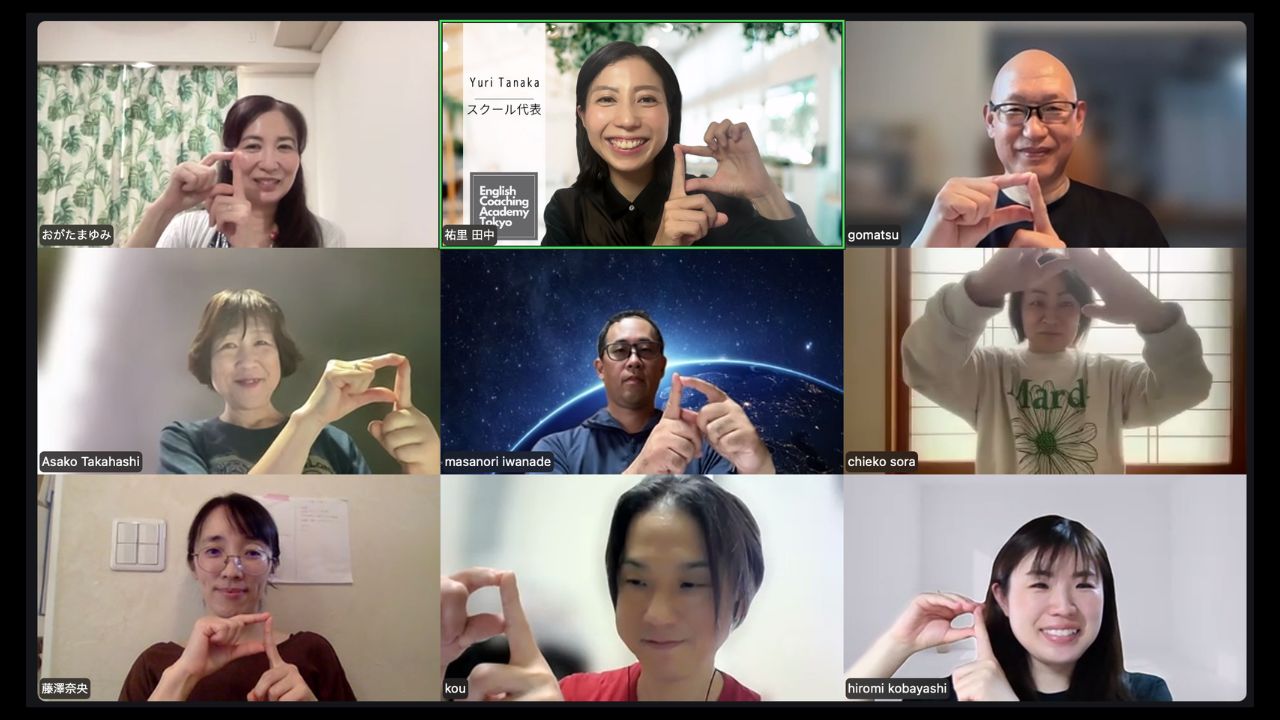
First, I asked everyone to high-five their own reflection on the screen.
Then, we high-fived one another through the screen.
All of this happened before I began my lecture.
At first glance, it is just a small physical gesture.
But I believe it can have a much bigger role in setting the tone of a room.
Instead of the instructor simply beginning to speak, everyone takes a physical action together.
The relationship changes subtly:
from
“one person speaks and everyone else listens”
to
“we are creating this experience together.”
That shift can happen in just a few seconds.
What I think about when I study TED Talks
I regularly coach speakers preparing for stages such as TEDx, and studying TED Talks is part of my everyday work.
One idea I often return to is Simon Sinek’s “Start With Why.”
TED describes Sinek’s work through the concept of the Golden Circle, which begins with Why. Simon Sinek — TED
What I did in this session was not an application of Sinek’s method itself.
Rather, I translated the underlying idea into my own approach to presentation design:
Before deciding what to say, consider why you are creating this space in the first place.
For this particular session, my Why was clear:
I wanted the participants, many of whom were meeting me for the first time, to feel comfortable, open, and ready to speak.
That was why I designed the first five seconds.
The inspiration came from Mel Robbins’ High 5 Habit
There was another source of inspiration behind this idea.
Mel Robbins, the internationally known speaker and author of The High 5 Habit, encourages people to high-five themselves in the mirror as a daily practice.
On her official website, Robbins describes the practice of looking at yourself in the mirror and giving yourself a high five as a way of building a more supportive relationship with yourself. Mel Robbins — Official Website
When I learned about this practice, I wondered:
What if the mirror were a Zoom screen?
On Zoom, we see our own face on the screen.
So I adapted the idea to an online environment.
Rather than treating the screen simply as a technical interface, I used it as an opportunity to create a moment of connection—with ourselves and with one another.
Why start with the body?
When we stand in front of people, we naturally focus on what we are going to say.
A speaker may think:
What should my opening line be?
How should I explain this?
Will people understand me?
Of course, preparation matters.
But while we are thinking about our words, the body is already responding to the situation.
Our facial expression.
Our breathing.
Our gaze.
Our posture.
The way our voice comes out.
And the subtle tension we may not even consciously notice.
All of these can communicate something to other people.
This is why, in Body Speech, I focus on something that happens before we speak:
the state we are in when we enter the room.
Body Speech is not simply about body language.
It looks at whether the body, words, and intention are aligned—and how that alignment creates trust and presence.
Instead of saying “Relax,” create the conditions for relaxation
In corporate training, presentations, and workshops, we often tell people:
“Relax.”
But telling someone to relax and actually helping their body become more at ease are two different things.
That is why I believe facilitators and speakers need to think beyond words.
We can use the body to help shape the state of the room.
The High Five was one small example of this.
For the participants, it took only a few seconds.
But those few seconds created a transition:
from
“I have come here to listen to a lecture”
to
“I am participating in this experience.”
What happened when we tried it?
Once we did the High Five, the atmosphere on the Zoom screen softened almost immediately.
Smiles appeared.
People became more animated.
And once the lecture began, participants actively asked questions, allowing us to address their concerns and challenges in real time.
Of course, I cannot claim that one simple gesture explains every change in the atmosphere.
But the experience reinforced something I have learned repeatedly through my work:
It is not only what you say first that matters. Sometimes, what you do together first matters just as much.
And I believe this applies both online and in person.
One more High Five at the end
At the end of the session, we did it again.
The first High Five was a celebration of ourselves for showing up and doing the work.
The second was a celebration of the people we had learned alongside.
A physical acknowledgment of both the beginning and the completion of the experience.
It created something more than simply saying,
“The session is over.”
It created a sense of:
“We shared this experience together.”
Designing the first five seconds
I do not believe presentation is simply a speaking skill.
Whether it is a keynote, corporate training session, meeting, or facilitated discussion,
communication begins before we speak.
That means designing more than just the content.
It means considering:
- How will you appear?
- What will your posture communicate?
- Where will you look?
- What kind of voice will you use for your first words?
- What physical experience will you invite your audience to have?
- What state do you want the room to enter?
I call this presence design.
Body Speech begins one step before speaking
Body Speech is a method for creating trust and presence by aligning body, words, and intention.
It is not simply about becoming a better speaker.
It begins with the state you are in before you speak.
The relationship you create with your audience.
The atmosphere of the room.
The way you use your body.
Your voice.
Your gaze.
And the intention you bring into the space.
The High Five was only one small example.
Change the body.
The state changes.
The room changes.
And the way your message is received can change.
This is the thinking behind Body Speech—a presence design method I have developed and systematized through many years of stage experience and my work coaching speakers and leaders.
Speaking, Training & Media
I speak and teach on topics including presentation, leadership communication, nonverbal communication, online communication, and presence design.
I also work with organizations and educational institutions that want to explore communication beyond conventional speaking techniques.
If your organization is asking questions such as:
- “Our people prepare carefully, but why does the message still land differently than intended?”
- “How can we create more engagement in online meetings and training?”
- “How can leaders develop a stronger presence when speaking to others?”
- “How can we approach presentation skills through the body, not only through words?”
I welcome opportunities for corporate training, keynote speaking, educational programs, and media interviews.
Learn Body Speech
I also offer an English-language Udemy course introducing the principles of Body Speech in a practical format:
Body Speech: Why Your Words Don’t Land — And How to Fix It
The course explores what happens before you speak—including presence, trust, nonverbal communication, and how to work with your body under pressure.
Because communication is not only about finding the right words.
It is also about the state from which those words are delivered.
Stop just speaking—and start being felt.

コメント