
By Mayumi Ogata | Founder of Body Speech | Global Speech Coach
“I want to erase my past.”
“Why am I the only one suffering like this?”
I used to live with these thoughts constantly.
My childhood trauma had taken deep, heavy roots in my heart, continuing to apply the brakes of self-denial—telling me “I am worthless”—even after I became an adult.
To break free from that, I tried everything I heard might help. Among them, there is one thing I have continued for 20 years: the combination of “Dialogue Journaling (self-dialogue notebook)” and “Walking.”
Embracing “Yin(Shadow)” and “Yang(Light)” to Nurture Your Inner Tree
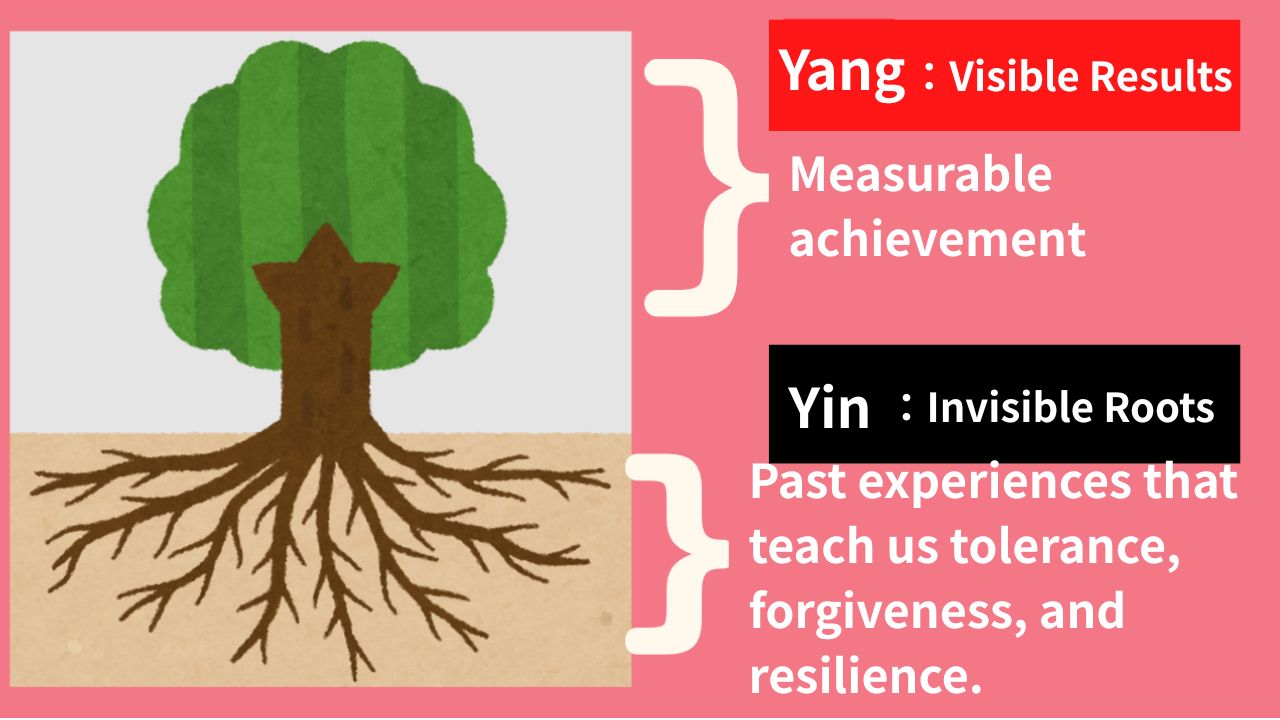
We tend to seek only the positive (Yang) and try to hide our negative emotions and past traumas (Yin).
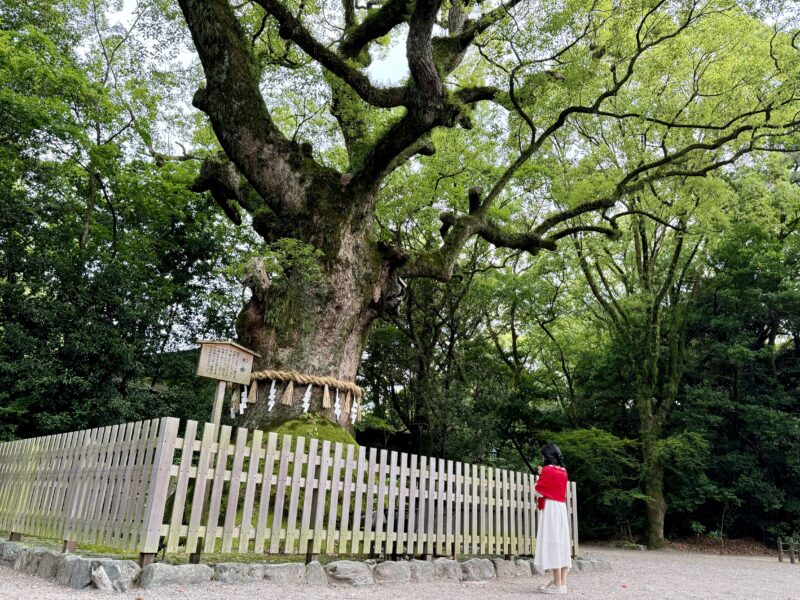
However, one day, while looking at the sacred tree at Atsuta Jingu Shrine, I suddenly had a realization.
To support the visible branches and leaves bathed in sunlight, there must be solid roots (a foundation) hidden beneath the soil; otherwise, the tree will collapse.
Why do we experience the Yin (shadow)?
Perhaps it is painful because we deny (resist) it. What if we just accept it all for a moment?
There is a saying that Yin and Yang are exchanged equally.
A person with a great light also has a great darkness. That means, since my darkness is great, my light must be great too… As I started writing such things in my journal, the way I perceived the world began to change.
Once I started looking at the light, I realized that the light exists thanks to the darkness.
At that moment, the scenery before me changed completely, as if all the Othello pieces had flipped at once.
Negative experiences and pasts you don’t want to look at—they all become the “roots” that support the tree that is you.
If a “God” resided within you, how would you treat yourself?
You would cherish, respect, and proudly allow yourself to exist there.
For a long time, I thought I had no value, so I couldn’t treat myself with care.
I felt something special about the sacred tree at Atsuta Jingu and went to see it over and over again. One day, I asked myself: “If I treated myself like a sacred tree, would I still think I am worthless?”
That was the turning point. It was then that I could truly believe, “I have value just by being.”
Tears overflowed and wouldn’t stop.
From this philosophy of “integrating Yin and Yang and treating oneself as a precious being,” my “Sacred Tree Theory” was born.
Actually, it took me a long time—about 20 years—to reach this state of mind.
In the past, I desperately wrote down “negative emotions” such as guilt, fear, despair, and past traumas in my notebook, constantly confronting them.
However, I realized that if you continue to focus on the negative, your heart becomes bound by that heavy energy, and you end up exhausted instead.
Psychology’s “Expressive Writing” (venting emotions) was certainly effective as an initial first aid.
But there is a trap: “If you continue to dig deep into negative emotions, the brain reinforces that negative vibration (frequency) and stays stuck there.” It took me about 20 years to realize this.
I don’t want you, reading this now, to take such a detour.
I want you to integrate yourself and become happy much faster, more lightly, and more flexibly.
For that purpose, I will introduce the latest “3 Processes to Rewrite Your Life’s Script” that I have arrived at.
The 3-Step Process
Step 1: Create a secure mental base through writing, and give yourself small “permissions”
When you are on the edge of despair, honestly, you cannot think of anything positive.
First, do not “deny” the negative. Acknowledge even the feelings of “I don’t want to do anything today” or “I’m exhausted” exactly as they are, and give yourself permission to feel that way.
- What to write?
Upon doing so, shift your perspective just a little bit.
Instead of forcing yourself to move forward or envision a big dream, look for comfort that fits your current self: “What brings me just a little relief right now?” or “What is a small thing I’m grateful for today?”
Negative emotions are simply signs telling you “what you truly desire.” Without feeling disgust or guilt toward them, try to collect words in your notebook that bring your heart “peace” and “comfort.” By slightly changing your focus, the resistance in your heart decreases, and your energy will stop draining.
In my case, I realized I had a core belief: “If I don’t work hard, my life won’t go well, and I won’t be loved.” Upon noticing this default setting, I wrote down how I truly wanted to be.
Then, thoughts like “I want to affirm myself just as I am,” “I want to stop blaming myself,” and “I want to acknowledge myself” came out.
As I continued writing, I realized that no one can love me unconditionally more than I can.
With that, I began to feel that I should do more things that make me comfortable, and I started giving myself a lot of permission.
The benefit of writing it down is that by visualizing (externalizing) what is in your head, your desires become clear. Because they become clear, energy flows toward them, and you can experientially feel what is known as the Law of Attraction taking place.
Step 2: Move your mind through your body by walking
Once you have tuned your mind to a “comfortable state (alignment)” with your self-dialogue notebook, step outside and walk.
Feel the outside air and let your energy circulate.
Our minds and energy are made of “waves.” This means they go up and down, so it is perfectly okay to have days where you take one step forward and two steps back.
Walking (a physical approach) triggers letting go. For example, even if you feel somewhat down, by walking and observing yourself objectively—thinking, “I got a little depressed today”—you will feel the waves of emotion naturally calm down.
You will become able to walk in order to accept the up-and-down emotions as a whole and circulate comfortable energy throughout your entire body.
- Why walk?
A rhythmic exercise of walking for 40 to 45 minutes releases “serotonin (the happiness hormone)” in the brain. By moving your body and feeling the wind and the scent of the seasons, your rigid perspective will physically expand.
By directing your consciousness to your body in the “here and now,” a thick, flexible axis—like that of a sacred tree—begins to form within you.
Step 3: View from the perspective of the Sacred Tree (Finding meaning and rewriting)
Once your mind is at peace and energy circulates through your body, finally, reexamine “past events” from a different angle.
In other words, look at the past from the perspective of the Sacred Tree (a higher dimension).
- How?
Step away from the victim’s perspective of “Why am I the only one suffering so much?” and look down on the past from the perspective of the “Sacred Tree (God)” within you.
Example: Change the question you ask yourself to, “What did I gain precisely because I had that experience?” (Reframing).
You should come to realize, “It is precisely because of that Yin (dark) experience that I was able to grow such deep, rich roots.”
There is no need to forcefully erase past trauma. Simply by shedding new “light (meaning)” on it, the “tragic heroine’s script” that bound your past will naturally be rewritten into the “protagonist’s script,” where you carve out your own future with your own power.
Triggered by a childhood trauma, I practiced
Dialogue Journaling (self-dialogue notebook) × Walking for 20 years.
I embodied the importance of accepting both positive (Yang) and negative (Yin) experiences,
and founded the “Sacred Tree Theory” to nurture the inner sacred tree.
Until the “inner sacred trees” of over 7,060 people regained their true essence
Through counseling and coaching, I have faced the hearts of more than 7,060 people so far.
Many of them, just like my past self, harbored unspoken traumas and deep self-denial.
However, those who did not deny the “Yin” within themselves, shifted their focus to “comfort (Yang),” and carefully grew their roots all grew into beautiful, strong sacred trees.
Trauma is by no means something that stands in the way of your life.
If you face it and change your focus, it transforms into your “greatest power” to deeply understand and gently embrace someone else.
If right now, you feel paralyzed by past pain, please stop the resistance of feeling like you “have to move,” and spend time doing nothing.
There were days when I, too, would just go out to the balcony, bask idly in the sun, and drink coffee.
As you forgive yourself in this way, surprisingly, the energy of “I want to do something” begins to well up little by little.
Only then, try opening your self-dialogue notebook.
The script of your life can be rewritten starting today, from this very moment.
コメント